Evaluate guide
CowAgent review: strengths, trade-offs and who it suits
An evidence-based CowAgent review covering features, setup effort, running costs, security considerations and the users it fits best.
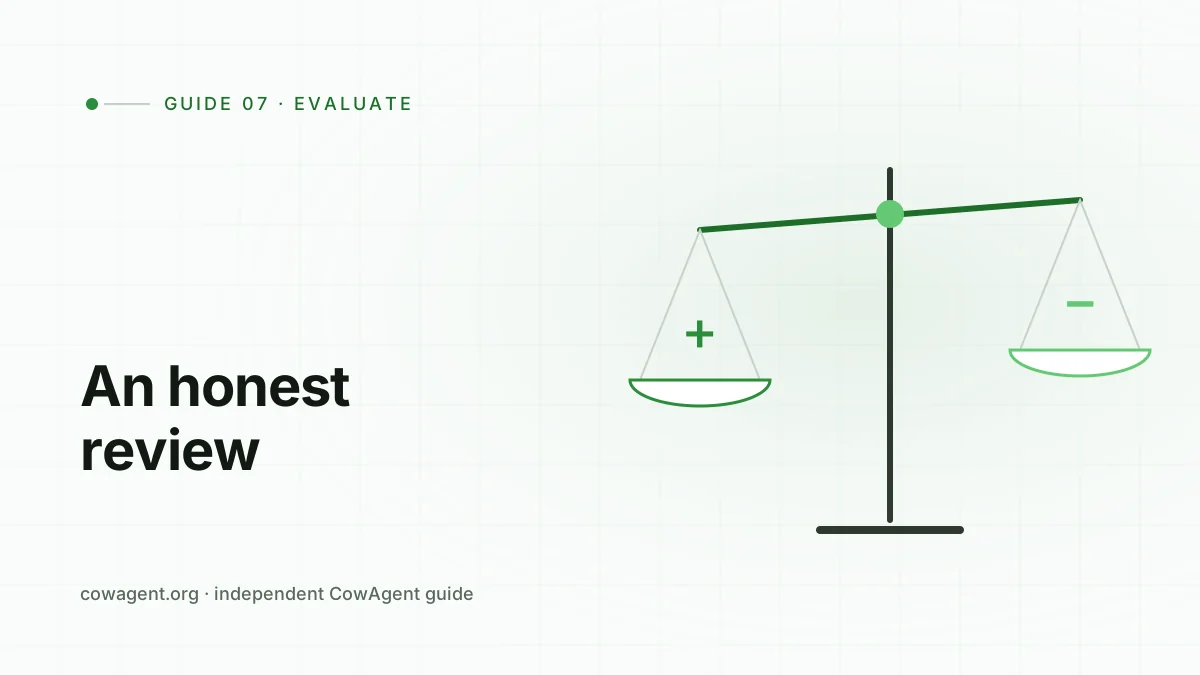
This review looks at CowAgent as documented in its README, documentation and release notes up to v2.2.1. We do not publish benchmark scores or user ratings, because we have not run controlled tests and will not invent numbers. What follows is a structured look at what the project offers, what it asks of you and who is likely to get the most from it.
Key takeaways
- CowAgent's strongest points are channel breadth, per-capability model routing and built-in memory.
- Its main costs are token usage in agent mode and the care needed when granting system access.
- It suits self-hosters and teams on Chinese workplace platforms especially well.
What this review covers
We assessed the features the project documents, the install routes, the release history and the guidance the maintainers give about costs and safety. Where a claim comes from the project itself, we say so. Your own results will depend on the model you connect, your hardware and the tasks you give it.
Strengths
- Channel breadth. Twelve documented channels, from the web console and Telegram to Feishu, DingTalk, WeCom and several WeChat options. Few agent projects cover Chinese workplace platforms this thoroughly.
- Flexible model routing. Chat, vision, image generation, speech and embeddings can each use a different provider, chosen from the console.
- Memory that is designed, not bolted on. Three tiers of memory, nightly Deep Dream distillation, a topic-based knowledge base and self-evolution work together.
- Several ways in. A desktop client with a bundled runtime, one-line installers, Docker and source installs cover most situations.
- Active development. Twelve releases between June and October 2026, each with detailed notes.
Trade-offs
- Token use. The maintainers say plainly that agent mode consumes substantially more tokens than chat. Budget for it.
- System access. The agent can run commands and edit files, so it belongs in a trusted environment with a protected console.
- Learning curve. Skills, MCP, memory tiers, multi-agent teams and many channels are a lot to absorb at first.
- Platform gaps. The desktop client covers Windows and macOS only; Linux users use the installer, Docker or source.
- Moving target. Frequent releases bring fixes, but tutorials and screenshots age quickly.
Who it suits
| If you are… | Fit | Why |
|---|---|---|
| A self-hoster who wants a 24/7 assistant | Strong | Runs on your own machine, with memory and scheduling |
| A team on Feishu, DingTalk or WeCom | Strong | Native channels with group-chat support |
| A developer extending an agent | Good | Decoupled layers and an open Agent Chat API |
| Someone wanting zero setup or costs | Weak | You still need a model provider and some configuration |
Verdict
CowAgent is a mature, fast-moving agent harness with an unusually strong channel story and a thoughtful memory design. If you are comfortable managing an API key and you can run it somewhere you trust, it is well worth trying, and the desktop client makes that trial quick. If you want a hands-off cloud assistant, a hosted service will suit you better.
Where to go next
Weighing alternatives? Read CowAgent vs OpenClaw. Ready to try it? Head to the CowAgent download.